
Indonesia's Coconut Shell Charcoal Exports, 2022 to 2024
Ministry of Agriculture data shows Indonesian coconut shell charcoal exports reached 203,010 tons in 2024, with destinations, product traits, and supply risks.

Indonesia’s coconut shell charcoal exports reached 203,010 tons in 2024, according to the Indonesian Ministry of Agriculture. Buyers from the Middle East to Europe import coconut charcoal briquettes from Indonesia.
Amid a global shift toward cleaner fuels, coconut shell charcoal briquettes, made from tropical agricultural waste, have become a sought-after product in international markets. From restaurant kitchens in Berlin to shisha tables in Riyadh, Indonesia is often cited as a quality benchmark for the origin.
Government data, FAO statistics, and comments from industry players point to a consistent pattern: Indonesia is the world’s largest coconut producer and an exporter of coconut shell charcoal whose volume rose in the years covered by official data. This article presents the main data points for overseas buyers looking for a stable, high-quality, and sustainable supply of coconut charcoal briquettes.
Official Export Data: Three Consecutive Years of Growth
Based on the 2025 Coconut Commodity Outlook published by the Center for Agricultural Data and Information Systems (Pusdatin), Secretariat General of the Ministry of Agriculture of the Republic of Indonesia, with data processed from the Directorate General of Estates and Statistics Indonesia (BPS), the export volume of Indonesian coconut shell charcoal under Harmonized System (HS) code 4402.20.10 was as follows:
| Year | Export Volume | Growth (YoY) |
|---|---|---|
| 2022 | 155,730 tons | Base year (after HS code separation) |
| 2023 | 191,170 tons | +22.8% |
| 2024 | 203,010 tons | +6.2% |
Since 2022, the government has separated the HS code for coconut shell charcoal (4402.20.10) from the general coconut charcoal code (4402.90.10) to make tracking data more precise. Since that separation, coconut shell charcoal export volume has increased for three consecutive years.[1, 2]
Commercial export shipping data for the ongoing 2026 period gives a provisional indication of market direction. The export value of Indonesian briquettes reached approximately US$56.5 million from more than 1,600 shipments, and coconut shell charcoal briquettes accounted for about 84.6% of total briquette export value, well above wood charcoal and other types of charcoal.[3]
In 2023, the total export value of charcoal and briquettes from Indonesia, with coconut shell charcoal as the main contributor, was nearly US$466 million, or about 43 percent of the global charcoal export market according to the ITC Trade Map database.[4] Statistics Indonesia also noted average growth in the export value of coconut charcoal briquettes of about 15 percent per year in recent years.[2] These figures cover different scopes and periods (all charcoal and briquettes in 2023, briquettes only in the ongoing 2026 period), so they are not directly comparable.
Finalized official full-year figures for 2025 and 2026 are not included in this article. The three-year trend relies on official data for 2022 to 2024. The 2026 shipping figures come from commercial records and are provisional, so they indicate market direction rather than final numbers.
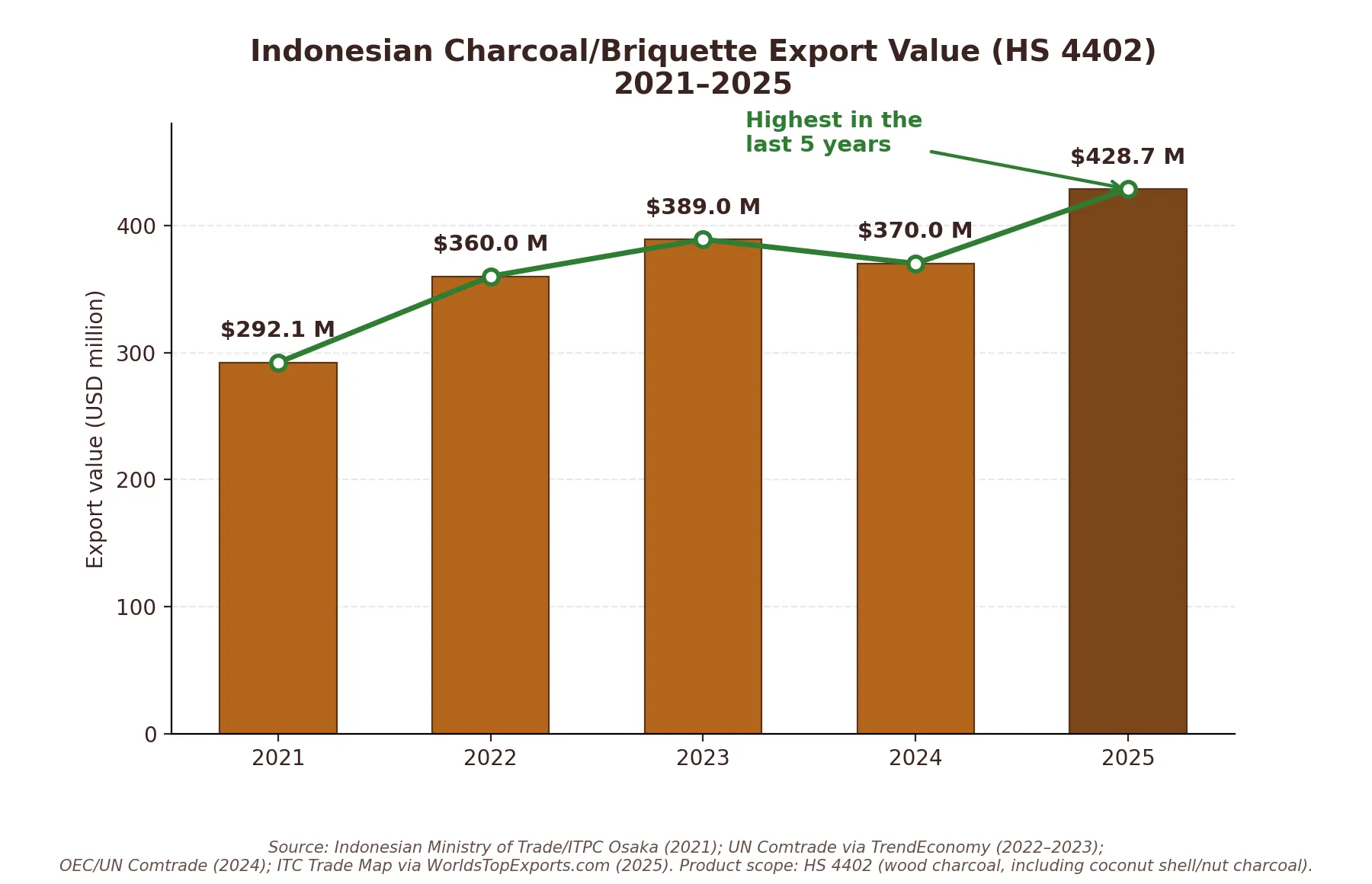
Chart: value of Indonesian charcoal and briquette exports under HS 4402 (includes wood charcoal), 2021 to 2025. The figures come from the databases named in the chart, which differ from the 2023 ITC Trade Map figure cited above.
Why Indonesia Is Often Cited as a Reference
The answer starts with raw materials. According to Food and Agriculture Organization (FAO) data processed by the Ministry of Agriculture’s Pusdatin, Indonesia is the world’s largest coconut producer, contributing an average of 27.28 percent of global coconut production from 2019 to 2023, ahead of the Philippines (23.14%) and India (22.10%).[1]
This large supply of raw material gives Indonesia a structural advantage. Coconut shells are available across more than 30 provinces, including Riau, North Sulawesi, East Java, and North Maluku.[1]
Volume alone does not decide a purchase, though. Quality is also a deciding factor for international buyers.
- In the 2025 Coconut Commodity Outlook, the Ministry of Agriculture’s Pusdatin describes Indonesian coconut charcoal as among the best in the world.[1]
- The 2025–2045 Coconut Downstreaming Roadmap prepared by the Ministry of National Development Planning/Bappenas notes that the characteristics of Indonesian charcoal are considered superior to charcoal from other countries, a key factor in Indonesia’s success in supplying shisha briquettes to the global market.[5]
Typical Characteristics Cited in Industry References
For buyers, quality claims need to be measurable. The characteristics below are cited in industry references as meeting export quality standards for Indonesian coconut charcoal briquettes.[3] They describe the product category in general and are not the specifications of any specific supplier’s product.
- High and stable calorific value: Gives strong heat output for shisha, barbecue, and industrial applications.
- Long burn time: Burns consistently for 2 to 3 hours without frequent replacement, which matters for shisha lounge operators and grill restaurants.
- Low ash content: Under 2.5 to 3 percent ash content, cleaner than wood charcoal or coal.
- Low smoke and no pungent odor: Produces minimal smoke and no pungent odor, so it does not affect the taste of food or shisha tobacco.
Industry references present these characteristics as making Indonesian coconut charcoal briquettes a sustainable substitute for wood charcoal in European markets sensitive to deforestation, and a common reference fuel for the shisha industry in the Middle East.[6]
Private-sector producers share this view. The owner of a coconut charcoal briquette manufacturer in Magelang, Central Java, who has exported to the United States, Europe, Australia, Asia, and the Middle East since 2018, noted that buyers from various countries travel directly to Indonesia to source shisha briquettes because of their consistent quality.[7]
Where Indonesian Coconut Charcoal Briquettes Are Shipped
The export map of Indonesian coconut charcoal briquettes covers a broad set of markets:
- Middle East: Saudi Arabia, Turkey, Lebanon, Iraq, Jordan, and the United Arab Emirates are major markets, driven by demand for premium shisha (hookah) briquettes. Recent shipping data identifies Saudi Arabia as the largest single destination, with trade value above US$10 million.[3]
- Europe: Germany is the main gateway to Western Europe, followed by the Netherlands and Belgium, mainly supplying eco-friendly barbecue fuel markets.[2, 3]
- Emerging markets: Russia, Brazil, and the United States show growing demand for premium BBQ briquettes and eco-friendly biomass products beyond the traditional Middle Eastern markets.[3]
- Asia: China regularly imports coconut charcoal for activated carbon used in the cosmetics and chemical industries, while Japan and South Korea consistently import it for alternative energy needs.[2]
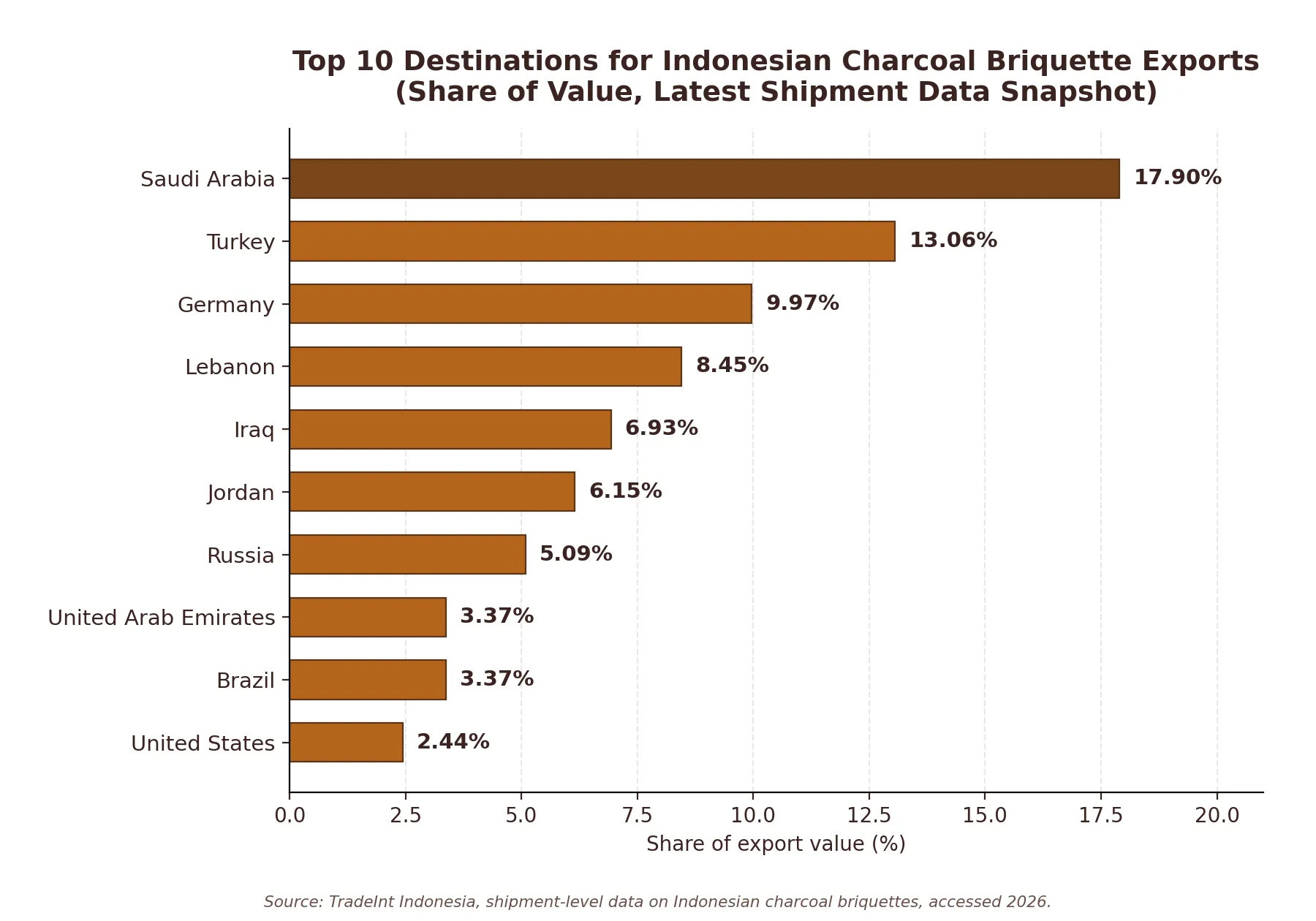
Chart: top 10 destinations for Indonesian charcoal briquettes by share of export value, from a TradeInt Indonesia shipment-level snapshot accessed in 2026.
Global demand for coconut charcoal briquettes is projected to grow by an average of 4.3 percent per year from 2024 to 2031. The global market value in 2024 was estimated to exceed US$421 million, according to research by Cognitive Market Research. The Asia-Pacific region is expanding at the fastest pace, while Europe and North America remain the highest-value markets because of their preference for eco-friendly fuels.[2]
Supply Chain Challenges
Indonesia’s coconut charcoal briquette supply chain also faces structural challenges.
Some farmers still sell whole raw coconuts abroad instead of processing them locally into shells ready for production, which can cause temporary raw material bottlenecks for domestic briquette producers.[2] In response, the Indonesian Coconut Charcoal Briquette Entrepreneurs Association (HIPBAKI) has urged the government to prioritize downstream processing. The government is currently evaluating export duties on whole coconuts to protect raw material availability for domestic manufacturers.[2, 3]
For international buyers, this dynamic is a signal that partnerships with exporters who have stable supply chains and clear production legality can become increasingly valuable. Early partnerships with credible Indonesian suppliers can support access to supply as market competition increases.
Conclusion
The data points to the following:
- Export volumes have risen for three consecutive years.
- Indonesia remains the world’s largest coconut producer.
- Government and development planning agencies describe the quality of Indonesian charcoal as a strength.
- Industry references describe technical characteristics that meet export quality standards in European, Middle Eastern, and American markets.
For buyers evaluating coconut charcoal briquette suppliers for long-term supply agreements, sourcing from the country with the largest coconut raw material base and a record of growing exports offers operational advantages.
References
- Center for Agricultural Data and Information Systems (Pusdatin), Secretariat General of the Ministry of Agriculture of the Republic of Indonesia. 2025 Coconut Commodity Outlook (export data processed from the Directorate General of Estates and Statistics Indonesia; world production data sourced from FAO). Jakarta, 2025. Available at: satudata.pertanian.go.id.
- Kompas.com (Agri Kompas). “Briket Arang Kelapa: Limbah Jadi Komoditas Ekspor,” published December 8, 2025, citing data from Statistics Indonesia and Cognitive Market Research.
- TradeInt Indonesia. “Ekspor Briket Indonesia 2026: Negara Tujuan, Jenis Produk, dan Eksportir Utama,” ongoing 2026 commercial export shipping data; quality specifications reference ExportHub Indonesia.
- Webekspor.com. “Potensi Ekspor Arang Briket Indonesia: Peluang, Nilai Pasar, dan Tantangannya,” citing the 2023 ITC Trade Map database and Statistics Indonesia.
- Ministry of National Development Planning/Bappenas. 2025–2045 Coconut Downstreaming Roadmap, as cited by ABRA Briket (abrabriket.com).
- The House of Representatives of the Republic of Indonesia (DPR RI), Center for Budget and Public Policy Analysis. “Potensi dan Permasalahan Produk Olahan Arang Kelapa,” state budget thematic analysis.
- GETI Media. “Indonesia Kuasai Pasar Ekspor Briket Arang Kelapa Terbaik di Dunia,” published July 7, 2025.