
Indonesian Coconut Shell Briquettes in the Middle East Market
Trade data, the raw coconut export debate, and quality standards that matter for Middle Eastern importers of Indonesian coconut shell briquettes.
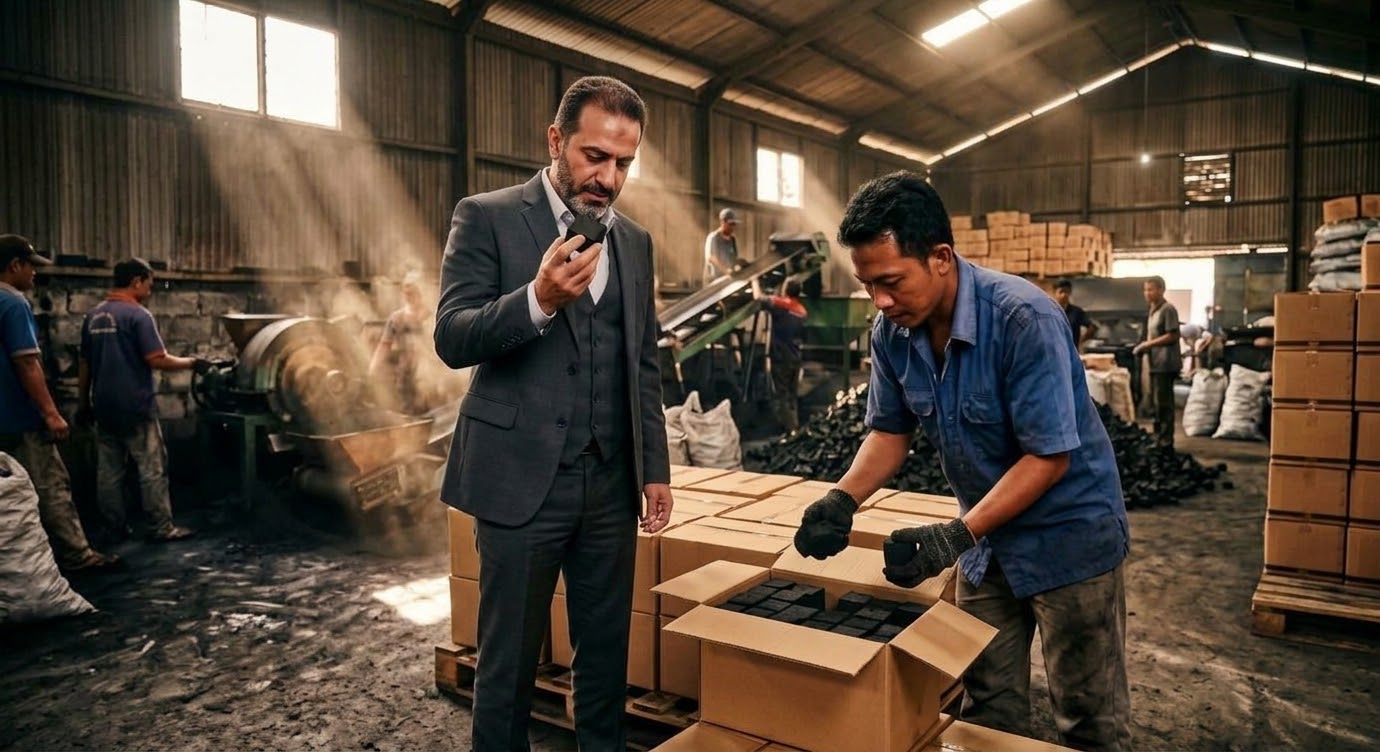
Behind the long-burning coals used in shisha pipes in Riyadh, Istanbul, and Amman is an export story rooted in Indonesian coconut shells. Recent trade data shows how large Indonesia’s role in this market has become, and what that means for Middle Eastern importers planning their supply.
Shisha Markets Lead Indonesia’s Briquette Exports
So far in 2026, Indonesia’s total briquette exports have reached US$56.51 million across 1,628 shipments (provisional figures for a year still in progress). At an estimated average 2026 exchange rate, that is more than 1 trillion rupiah. Coconut-shell charcoal briquettes (Harmonized System code 440220) account for 84.61% of that value, which reflects Indonesia’s leading position among coconut charcoal briquette exporters [1].
The top three destinations this year are all closely tied to shisha culture:
- Saudi Arabia leads with US$10.11 million
- Turkey follows with US$7.38 million
- Germany comes third with US$5.64 million (it also serves Europe’s shisha lounge scene) [1]
Market research firm DataIntelo puts the Middle East and Africa’s share of the global coconut charcoal briquette market at roughly 9.3% in 2025, with the fastest projected growth rate worldwide (a compound annual growth rate, or CAGR, of around 9.1%) through 2034. The United Arab Emirates alone is home to more than 3,200 licensed shisha lounges, and total charcoal consumption across the Middle East is estimated to exceed 95,000 metric tons a year [2]. For importers, these figures describe a market projected to keep growing, one that needs a dependable supply chain over the long term.
The Raw Coconut Export Debate
Since late 2024, the Indonesian Coconut Processing Industry Association (HIPKI) has repeatedly urged the government to impose export levies or a moratorium on raw coconut exports. It argues that raw material for briquette makers is being sent overseas, which helps build competing downstream industries in China and Thailand [3]. In October 2025, Agriculture Minister Amran Sulaiman signaled a plan to halt all raw coconut exports, some 2.8 million tons a year, to encourage more value-added processing at home [4].
As of May 2026, Trade Minister Budi Santoso confirmed that the government still could not impose the export levy, in order to protect farmers’ incomes. Those incomes have risen as coconut prices climbed from around Rp2,000 to Rp7,000–8,000 per nut on strong global demand [5]. By July 2026, HIPKI was still pressing its case, proposing export duties and restrictions on mature-coconut exports to protect the domestic raw material supply, projected at just 459,659 tons for 2026 [6].
The debate has run for more than a year and remains unresolved. Its outcome could affect raw material availability and pricing for Indonesian producers, and with them the supply and pricing of finished briquettes. Importers may find it useful to factor this uncertainty into long-term supply arrangements with certified briquette producers.
Quality Standards
Indonesian coconut charcoal briquettes are tested against the Indonesian National Standard (SNI) 01-6235-2000, which caps moisture content at 8% and ash content at 8–10% [7]. Premium export markets, particularly Middle Eastern shisha buyers, typically ask for tighter specifications. The figures below are general market expectations, not the specifications of any single producer:
- Ash content: 2–3% range
- Calorific value: Above 6,000–7,000 cal/g
- Performance: Minimal smoke, and no chemical additives
Field research suggests these specifications are within reach for Indonesian coconut-shell charcoal, whose raw material characteristics are generally considered favorable compared with wood charcoal or mangrove-based alternatives [8]. Raw coconut shells cost around Rp6,000 per kilogram, but once processed into export-grade briquettes they can fetch roughly US$1,300 per ton abroad. The government estimates this value chain could generate up to Rp6.8 trillion a year in foreign exchange if downstream processing is scaled up consistently [8].
Export Governance Reform
Since June 2026, Government Regulation No. 24/2026 has required strategic natural resource commodities, initially coal, palm oil, and ferroalloys, to be exported through a single state-owned gateway, PT Danantara Sumberdaya Indonesia. The aim is to close loopholes for under-invoicing and transfer pricing that have reportedly cost the state hundreds of trillions of rupiah [9].
Coconut charcoal briquettes are not currently covered by this scheme. The reform is still worth following. Its push for pricing transparency and integrated data-sharing across customs, tax, and banking authorities points to more accountable trade governance, which matters to trading partners who value certainty and legal clarity in their transactions.
Practical Considerations for Importers
Based on the information above, three points are worth considering:
- Look toward certified finished-briquette producers rather than raw-material aggregators, to reduce exposure if restrictions on raw coconut exports are introduced.
- Check export documentation up front, including business licenses, phytosanitary and fumigation certificates, and SNI or independent lab test results, before signing long-term contracts. This is in step with the transparency push the government is currently promoting.
- Consider securing supply contracts early, while raw material prices remain relatively stable, given the sustained upward trend in farm-gate coconut prices since 2025.
Domestic producers and exporters are also positioning themselves as long-term supply partners for Middle Eastern buyers. One example is PT Harapan Agri, a government-supported small industry in Banten, which shipped its first export consignment to Saudi Arabia [10].
Summary
Rising shisha demand across the Middle East, Indonesia’s leading position in the global coconut briquette market, and the unresolved raw coconut export debate all point in the same direction. Importers have good reason to build long-term relationships with credible, transparent Indonesian suppliers.
References
- TradeInt Indonesia, “Indonesia Briquette Exports 2026: Destination Countries, Product Types, and Leading Exporters,” 2026. tradeint.id/blog/dasar-data-perdagangan/ekspor-briket-indonesia
- Hi-Fella Insights, citing DataIntelo market research, “The Potential of Indonesian Coconut Charcoal Briquettes in Global Export Markets,” June 2026. blog.hi-fella.com/potensi-briket-arang-kelapa-indonesia-di-pasar-ekspor-global
- Kontan.co.id, “Indonesia’s Raw Coconut Exports: Industry Players Say It’s Creating Competitors to Domestic Downstream Processing,” September 2024. industri.kontan.co.id/news/indonesia-ekspor-kelapa-bulat-pelaku-industri-ciptakan-kompetitor-untuk-hilirisasi
- Kontan.co.id, “After Driving Prices Up, Whole Coconut Exports Set to Be Banned,” October 10, 2025. nasional.kontan.co.id/news/sempat-bikin-harga-melonjak-ekspor-kelapa-utuh-akan-dilarang
- Kompas.com, “Protecting Farmers, Government Still Can’t Impose Export Levy on Raw Coconuts,” May 13, 2026. money.kompas.com/read/2026/05/13/211517526/lindungi-petani-pemerintah-belum-bisa-pungut-bea-ekspor-kelapa-bulat
- Kompas.id, “Averting a Nationwide ‘Coconut War,’” July 23, 2026. kompas.id/artikel/menangkal-perang-kelapa-nusantara
- Indonesian National Standard SNI 01-6235-2000 on Charcoal Briquettes, as cited in various agricultural engineering journals (e.g., Andalas University’s Journal of Agricultural Technology;
ppjp.ulm.ac.id). - Kompas.com (Agri), “Coconut Charcoal Briquettes: Waste Turned Export Commodity,” December 8, 2025. agri.kompas.com/read/2025/12/08/170000384/briket-arang-kelapa–limbah-jadi-komoditas-ekspor
- IKPI / Bisnis.com, “Regulation 24/2026 Officially Centralizes Strategic Natural Resource Exports Through a State-Owned Gateway,” June 2026. ikpi.or.id/pp-24-2026-resmi-sentralisasi-ekspor-sda-strategis-lewat-bumn
- Antara Banten, “Charcoal Briquettes Produced by Banten Provincial Government-Backed Small Industry Make First Export Shipment.” banten.antaranews.com/berita/262200/briket-arang-produksi-ikm-binaan-pemprov-banten-ekspor-perdana